- Short Squeez
- Posts
- 🍋 SpaceX Files for IPO
🍋 SpaceX Files for IPO
Plus: Nike CEO vents about poor earnings, how much sleep bankers are actually getting, Ken Griffin's plan to reshape Miami, and more private credit trouble at KKR.

Short Squeez
April 02, 2026

Together With

“I’m so tired, and I know you are too, of talking about fixing this business.” — Nike CEO after earnings
Good Morning! The group accusing David's protein bars of overstating calories dropped its lawsuit. KKR's non-traded private credit fund curbed redemptions after a spike in repurchase requests. And Nike's CEO is "tired" of talking about fixing the company.
Dimon says the U.S. must prioritize Iran over short-term market pain. OpenAI demand is sinking in secondary markets as Anthropic steals the spotlight. And gold is on track for its worst month in 17 years as rate-cut hopes fade.
Plus: The fund beating 99% of peers betting on Taiwan's smaller AI stocks, Ken Griffin's plan to reshape Miami, and Red Lobster bringing back the endless shrimp that drove it into bankruptcy.
The best finance workflows start with a plan. Build the perfect agent workflow with Plan Mode from F2.
SQUEEZ OF THE DAY
SpaceX Files for IPO
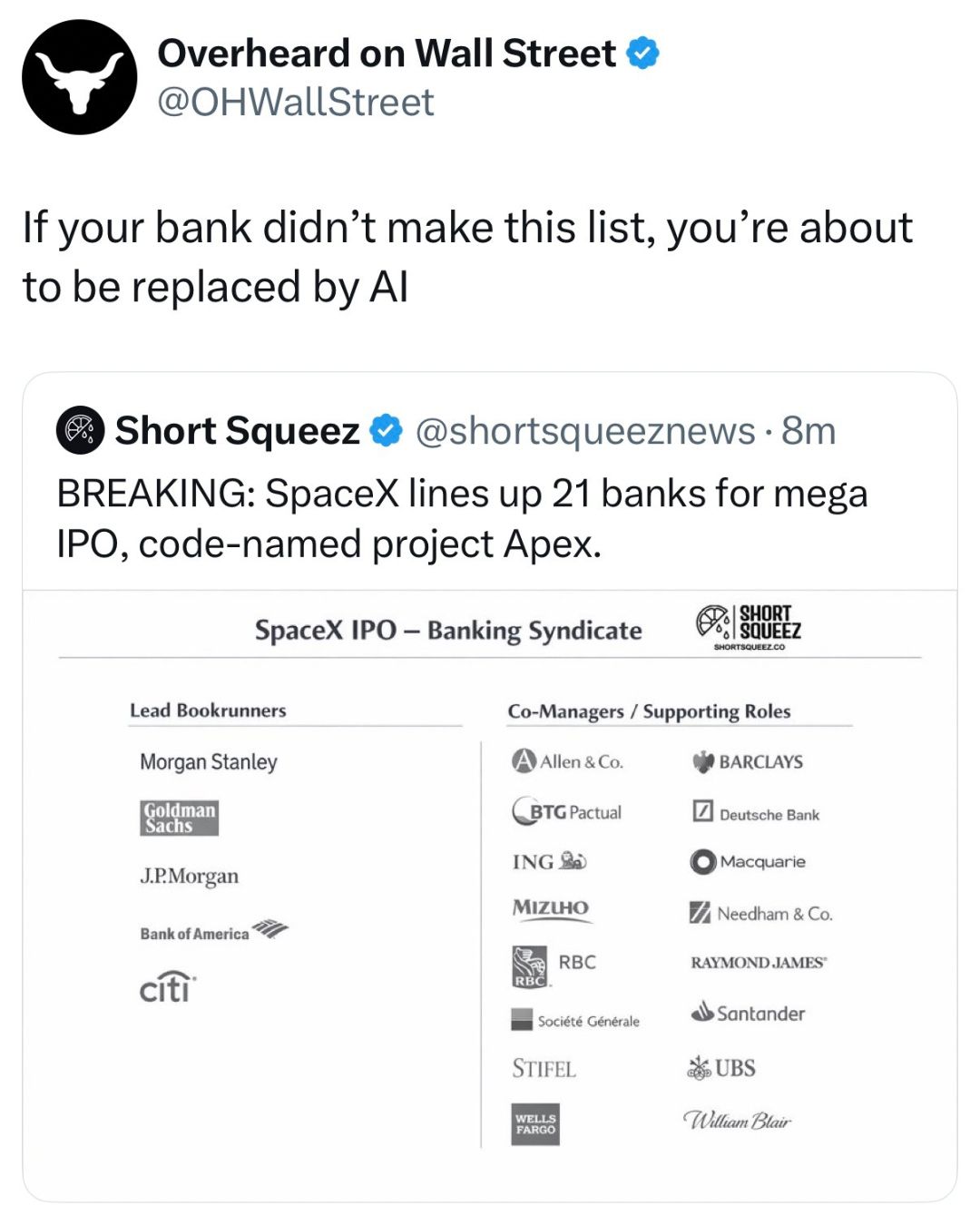
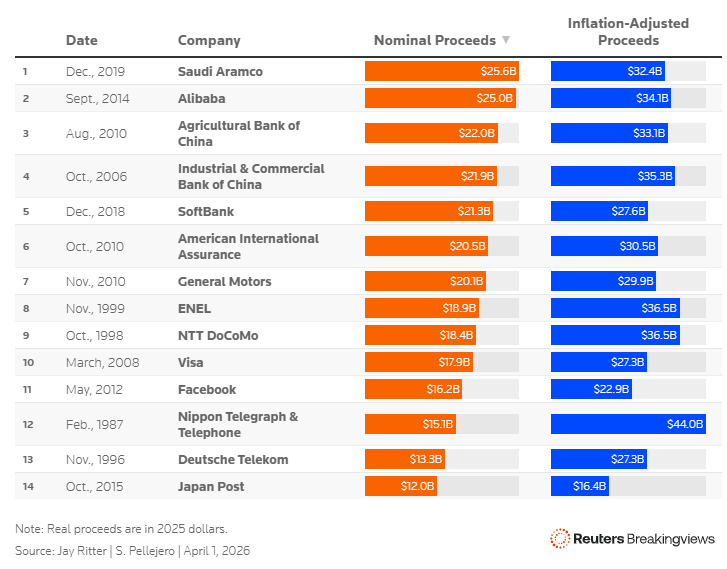
Elon Musk’s SpaceX, which was founded in 2002 with the stated goal of colonizing Mars, finally confidentially filed for an IPO. SpaceX’s debut could become the largest stock market entry ever, potentially surpassing Saudi Aramco’s 2019 listing. SpaceX is reportedly seeking a valuation above $1.75 trillion, which would make it the first company to enter public markets above the $1 trillion mark.
The confidential SEC filing means the financials and risk factors are still hidden for now, but that is standard. Companies often file privately first so they can negotiate comments with the SEC before the full registration becomes public.
Based on current reporting, SpaceX could begin trading as soon as June or July, with investor meetings expected in April and May. The company is also reportedly lining up one of the deepest bank syndicates in years, 21 banks featuring Morgan Stanley, Goldman Sachs, JPMorgan, Bank of America, and Citigroup as lead bookrunnners.
Over the last two decades, Musk built the world’s dominant private launch company, made reusable rockets commercially viable, and turned Starlink into the real financial engine of the business. SpaceX generated roughly $15 billion to $16 billion in revenue in 2025 and about $8 billion in profit, with Starlink accounting for 50% to 80% of revenue and serving more than 9 million users through over 9,500 satellites.
NASA now accounts for only about 5% of revenue, which means the valuation case rests less on government contracts and more on SpaceX’s ability to act like a global telecom and infrastructure business.
There is also a new wrinkle: earlier this year, SpaceX merged with xAI, folding Musk’s AI ambitions into the company and turning the IPO into something broader than a rocket listing. The combined company now spans launch, satellite broadband, AI, and even long-shot plans for solar-powered orbital data centers. That means investors are not just buying exposure to rockets and Mars. They are buying a hybrid of a defense contractor, broadband utility, AI infrastructure play, and Musk holding company.
The prospectus will matter because public investors are finally going to get a real look at the economics, the risk factors, and the governance of a company that has mostly operated in the dark for 23 years.
Takeaway: One of the most important capital markets events in years, maybe the most important. But the more interesting story is what public listing requirements actually do to Musk's empire.
SpaceX has spent two decades answering to private investors who bought the vision first and asked questions later. Quarterly earnings calls, public shareholders, and SEC disclosures are a very different sport. The market is about to find out what SpaceX actually earns, how much of the story is really Starlink, and whether investors will pay $1.75 trillion for a company selling them rockets, internet, AI, and Mars all at once.
Oh, and congrats to every ECM banker on their 2026 bonus.
PRESENTED BY F2
AI That Won’t ‘Jump the Gun’

Isn’t it the most frustrating thing when you prompt GPT, Claude, Grok (insert your favorite finance AI here), and they immediately jump to working rather than listening and planning?
Thus follows the typical AI workflow in finance:
1) Run it. 2) Review it. 3) Find assumption errors. 4) Redo it.
While AI may be helpful, it has a tendency to act first and ask questions later (unless prompted).
Plan Mode from F2 lets you review the entire workflow before it runs:
the logic
the assumptions
the build path
Build the plan upfront, let the agents handle the grunt work.
This equates to fewer drafts, faster outputs, and way less time retracing steps.
See how Plan Mode works.
HEADLINES
Top Reads
Lawsuit over calories in David protein bars dropped (NBC)
KKR curbs redemptions in non-traded private credit retail fund (BB)
Nike CEO vents as company struggles to regain footing after disappointing profits (NYP)
Dimon says US must prioritize success in Iran over markets (CNBC)
OpenAI demand sinks on secondary market as Anthropic runs hot (BB)
Gold set for worst month in more than 17 years as US rate-cut hopes fade (CNBC)
Fund beating 99% of peers bets big on Taiwan's smaller AI stocks (BB)
Ken Griffin wants to reshape Miami — and maybe American politics (Fortune)
Google readies revamped, screenless Fitbit to rival growing Whoop craze (BB)
What banks stand to lose from the private credit mess (WSJ)
Franklin Templeton acquires digital assets investment firm in active crypto management push (CNBC)
OECD predicts higher inflation than Fed — what that means for your money (CNBC)
Data center investment rivals oil, gas, and renewable energy (Axios)
Anthropic does damage control after Claude Code leak, Iran threatens Big Tech operations (YF)
Oura and Whoop discounts gain popularity with premium Amex, Chase credit cards (BB)
Oracle data center nears $16 billion financing after twisty path (BB)
Endless shrimp returning to Red Lobster under new CEO (BB)
HEARD ON THE STREET
How Much Sleep Are Bankers Getting?
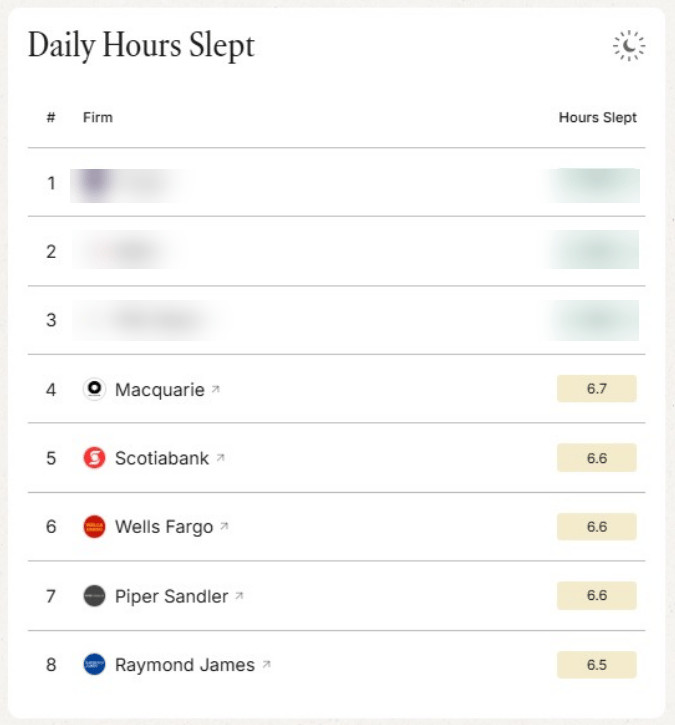
Investment banking is the most burned out industry in finance, scoring 40/100 on our burnout index. Investment bankers average just 6.3 hours of sleep per night, the lowest of any finance industry.
But three banks are beating the average by a wide margin, averaging more than 7 hours. Find out which ones on Wall Street 360.
CAPITAL PULSE
Markets Rundown

Market Update
Stocks extended gains as optimism around a potential end to the Iran conflict continued to build
Major indexes moved higher for a second straight session, building on yesterday’s strong rebound
Oil prices dipped slightly, though still elevated and sensitive to developments in the Strait of Hormuz
Bond yields edged higher following stronger-than-expected economic data
Markets are increasingly pricing in de-escalation, though uncertainty remains
Macro Strength Beneath the Surface
Recent data continues to point to a resilient U.S. economy heading into the energy shock
Consumer spending came in strong, reinforcing a solid demand backdrop
Labor market showed signs of stabilization, with hiring modestly improving
Wage growth remains healthy, supporting continued consumer strength
Overall, the economy entered this period from a position of underlying strength
Movers & Shakers
(+) Dave & Buster's ($PLAY) +16% after the restaurant and entertainment chain announced strong Q4 earnings.
(–) Nike ($NKE) -16% because the footwear giant announced disappointing earnings.
(–) Restoration Hardware ($RH) -19% after the upscale home-furnishings company announced an earnings miss.
Prediction Markets

March job numbers come out tomorrow at 8:30am EDT.
Trade on real-world events with Kalshi. Use code OWS to get a $10 bonus when you trade $10.
Private Dealmaking
KKR will acquire Taiyo Holdings for $3.3 billion
Saronic, a developer of autonomous military ships, raised $1.75 billion
StarCloud, a developer of orbital data centers, raised $170 million
ScaleOps, a computing resource allocation platform, raised $130 million
Ambrosia Biosciences, an obesity biotech, raised $100 million
OpenFX, an FX infrastructure platform, raised $94 million
For more PE, VC & M&A deals, subscribe to our Buysiders newsletter.
BOOK OF THE DAY
Almost Reckless

Description:
A thoughtful exploration of how to take smart, calculated risks without falling into chaos, from Amy Smilovic. The book blends creativity with pragmatism, showing how bold decisions can be made with structure, taste, and discipline. It emphasizes navigating uncertainty with clarity, building confidence through action, and knowing when to trust instinct versus process in high-stakes environments.
Book Length: 256 pages
Release Date: March 3, 2026
Ideal For:
Creatives, founders, and operators who want to take bigger swings while maintaining control, discipline, and long-term vision
The goal is not to avoid risk it is to take the kind of risks that move you forward without losing yourself in the process.
DAILY VISUAL
SpaceX Bout to Smash Records
Biggest IPOs
PRESENTED BY MOSAIC
How Reliable Are LLMs for Financial Modeling?

AI has transformed how Wall Street handles language-based work. Summarizing earnings calls, processing CIMs, drafting memos… for tasks like these, LLMs are definitely a game changer.
But financial modeling is a different problem entirely.
LLMs are probabilistic by nature. Run the same model twice and you get two different answers. For a summary of an expert call, that's fine. For an LBO supporting a multi-billion dollar investment decision, that's a structural problem.
A financial model needs to be 100% correct. A 99% accurate LBO is still a wrong LBO. And LLMs are nowhere near 99%...
AI adds more randomness to a system that needs less.
What firms actually need is purpose-built software where the math is locked in and never in doubt. Not AI making it up as it goes.
That's the approach Mosaic takes, fully automating the LBO process so the output is the same every single time. The questions on a deal should be about the business, not whether the math is working correctly.
DAILY ACUMEN
Controlled Burn
There is a version of quitting that is failure and a version that is precision. Most people cannot tell them apart, including the person doing the quitting, which is what makes the decision so brutally hard in the moment.
Persistence is a virtue until it becomes the story you tell yourself to avoid admitting the thesis was wrong. The investor who holds through a correction builds wealth. The investor who holds through a broken thesis builds losses and calls it conviction.
Knowing when you are being disciplined and when you are just being stubborn might be the most valuable and least discussed skill in any long game.
ENLIGHTENMENT
Short Squeez Picks
What do you want your days to actually look like?
How to reduce screen time
Less forceful ways of expressing disagreement
A mutual fund manager’s top investing advice
5 ways to turbocharge your workout
MEME-A-PALOOZA
Memes of the Day

📣 Partner With Us: Get in front of an audience of over 1 million finance professionals, business leaders, and policy influencers. Submit a partnership inquiry.
📈 Grow With Us: Work directly with the Overheard on Wall Street team to scale your finance brand. Schedule your free consult.
🔒 Short Squeez Premium – Insiders: Access exclusive content, including investment analysis, wellness features, career tools, and our full recruiting resource library. Upgrade to Premium.
🧢 Wall Street Shop: Explore our collection of finance-themed apparel and merchandise. Visit the shop.
📬 Deals Newsletter – Buysiders: A curated roundup of major M&A, private equity, and VC activity. Plus access to private deal flow. Subscribe here.
What'd you think of today's edition? |
Reply