- Short Squeez
- Posts
- 🍋 Make As Rare Again
🍋 Make As Rare Again
Plus: Anthropic is closing in on a $900 billion valuation, eBay swatted away GameStop, and Goldman's own president is calling the bank a human assembly line.

Short Squeez
May 13, 2026

Together With

"I often describe Goldman Sachs as a human assembly line. Our human assembly lines will become more digitized, digital agents will be our robots." — John Waldron, Goldman Sachs President
Good Morning! eBay formally rejected GameStop's $55 billion takeover bid, calling it "neither credible nor attractive." Trump called Ken Griffin an "amazing businessman" on the radio and urged Mamdani to "cherish billionaires," warning it's "not recoverable" for NYC to lose people like him.
Spirit Airlines' bankruptcy advisers have billed $80 million and counting, led by Davis Polk at $26 million and FTI Consulting at $24 million. And Anthropic is in talks to raise $30 billion at a $900 billion valuation.
Plus: e.l.f. Cosmetics co-founder Scott Vincent Borba is giving up his fortune from the $3 billion business to be ordained a Catholic priest on May 23, Blue Owl reported a 95% YoY drop in retail investment inflows. And Goldman's president says the bank is a "human assembly line" facing automation.
AI may be hot, but oil is still king. And, Greenland Energy potentially has a lot of it. Learn about the opportunity here.
SQUEEZ OF THE DAY
Make A’s Rare Again

Harvard is considering a crackdown on grade inflation, which means the easiest part of being a Harvard student may no longer be getting an A.
Faculty are voting this week on a proposal that would limit solid A grades to 20% of students in a class, plus four extra A’s per course. The move comes after A’s basically became the default grade in Cambridge.
Solid A’s now account for nearly two-thirds of all undergraduate grades, up from roughly one-quarter 20 years ago. More than 50 students in last year’s graduating class reportedly finished with perfect GPAs, which is impressive, but also kind of defeats the purpose of grades.
If everyone gets an A, the A stops telling employers, grad schools, and scholarship committees very much. Harvard is trying to restore some signal to the transcript. The problem is that at elite schools, the signal is not just academic. It feeds directly into recruiting, especially for investment banking, consulting, law school, and other prestige-track jobs where small differences in GPA can become résumé-screening ammo.
That is where this gets messy. If Harvard students now have to fight to land in the top 20% of every class, the recruiting calculus changes. Instead of spending sophomore fall networking with bankers, drilling accounting technicals, and pretending they have always been passionate about M&A, students may spend more time protecting their GPA. That creates a real trade-off: do you chase the A in a class full of other kids who all got 1550s, or do you spend that time building the relationships and interview reps that actually get you the Goldman first round?
And it is not like Harvard students suddenly got less smart. That is part of the problem. At schools like Harvard, a huge share of the class is capable of A-level work. So a cap does not just separate the prepared from the unprepared. It forces professors to rank highly qualified students against each other in a much tighter curve.
Supporters say the proposal is modest because it does not cap A-minuses, and the extra four A’s help smaller seminars. Critics say it creates quota-style grading and could hurt students competing against peers at schools without similar restrictions.
There is also precedent for the backlash. Princeton and Wellesley both tried anti-grade-inflation policies and later rolled them back after concerns about stress, quotas, and unintended consequences.
Princeton’s own review found no measurable harm to graduate competitiveness, but the perception still mattered. In elite recruiting, perception is half the game. Nobody wants to be the school where students have to explain that their 3.55 is actually good because the faculty decided to get stingy with A’s.
Takeaway: Harvard’s grade inflation problem is real. When two-thirds of grades are A’s, the transcript starts looking more like a participation trophy. But capping A’s creates a different problem: students may spend even more time optimizing for GPA and less time building the skills, networks, and interview reps that actually matter for jobs. For Wall Street recruiting, the irony is pretty rich. The school trying to make grades more meaningful could make students even more obsessed with them.
PRESENTED BY GREENLAND ENERGY COMPANY
The Land of Liquid Gold?

For the past year, Greenland has been the center of a geopolitical conversation that spans the White House, NATO, and every major energy desk on Wall Street. The US Geological Survey has estimated the island holds roughly 31 billion barrels of oil equivalent in untapped resources, and the Trump administration has made Arctic resource security a cornerstone of its foreign policy agenda.
One key player, Greenland Energy Company, already holds the rights to earn up to a 70% working interest across the Jameson Land Basin, the largest onshore basin on the island, which equates to roughly 13 billion barrels. It covers more than two million acres with 58 identified prospects and a drilling campaign contracted to Halliburton. They’re scheduled to start drilling in the second half of 2026.
Read more about GLND and the opportunity here.*
HEADLINES
Top Reads
eBay rejects GameStop's takeover bid from Ryan Cohen (CNBC)
Trump urges Mamdani to ‘cherish’ billionaires as Ken Griffin plots Miami move (NYP)
Adviser fees hit $80m and counting in Spirit Airlines bankruptcy (FT)
Anthropic in talks to raise $30 billion at $900 billion valuation (BB)
e.l.f. Cosmetics co-founder donates fortune to become a priest (NYP)
JPMorgan Chase-led bank group reins in credit line to troubled KKR private credit fund as losses mount (CNBC)
Blue Owl retail fundraising evaporates amid private credit concerns (FT)
Goldman president says bank is 'human assembly line' facing automation (BB)
VC firm takes less-is-more approach with new $450 million fund (BB)
Jamie Dimon urges US, Europe to resolve 'stupid' trade issues for growth (BB)
Mamdani scraps planned NYC property tax hike in revised budget (BB)
Anthropic warns investors to avoid certain secondary market sellers (BB)
Surprise! The best pizza in NYC is at this new Japanese restaurant (NYP)
JPMorgan, Wall Street use blockchain in $13 trillion repo market (BB)
JPMorgan's markets business is booming after record quarter (BB)
Blackstone's Jon Gray: the $26 billion bet that felt career-shortening (BB)
Manhattan's 'hell hole' is now in one of its hottest office districts (WSJ)
Carlyle BDC cuts dividend even as it flags better credit market (BB)
JPMorgan and the delicate art of paying off employees (WSJ)
Elon Musk's Grok is losing ground in AI race (WSJ)
Harvard grade inflation plan to limit A marks in undergrad classes (BB)
CAPITAL PULSE
Markets Rundown

Market Update
U.S. equities closed lower after April CPI inflation came in modestly hotter than expected
The pullback reflected a broader risk-off tone, with technology and consumer discretionary stocks leading declines
Defensive sectors including health care and consumer staples outperformed
Treasury yields moved higher as investors pushed back expectations for future Fed rate cuts
International markets were weaker overnight, with both Asian and European equities finishing lower
WTI oil prices continued climbing amid ongoing disruptions in the Strait of Hormuz
The U.S. dollar strengthened against major currencies alongside higher bond yields
Inflation Remains Sticky
Headline CPI rose 3.8% year-over-year in April, slightly above expectations of 3.7%
Elevated energy prices remained the primary driver, with energy inflation up nearly 18% from a year ago
Core CPI also ticked higher to 2.8%, reinforcing concerns that inflation normalization may take longer than hoped
Shelter inflation accelerated as well, adding further upward pressure to the report
Persistent inflation, combined with a stabilizing labor market, likely keeps the Fed firmly on hold in the near term
Markets increasingly view policy easing as delayed unless energy prices meaningfully normalize later this year
Labor Market Continues to Stabilize
ADP employment data showed private employers added an average of 33,000 jobs per week over the past month
Hiring trends remain modest but continue moving gradually higher
Slower labor-force growth tied to demographics and immigration trends is helping support low unemployment despite softer hiring levels
The broader labor backdrop still points toward:
Limited layoffs
Stable household income growth
Near-full employment conditions
Movers & Shakers
(+) Wendy’s ($WEN) +17% after Nelson Peltz’s Trian Fund Management, the chain’s largest shareholder with a ~16% stake, is seeking investor backing to take the company private.
(–) Hims & Hers ($HIMS) -14% because Q1 revenue missed estimates and the company cut its full-year revenue guidance.
(–) Under Armour ($UAA) -17% after fiscal 2027 EPS guidance missed analyst estimates.
Prediction Markets

Watch Wednesday: the Omega Index
Trade on real-world events with Kalshi. Use code OWS to get a $10 bonus when you trade $10.
Private Dealmaking
Digital Asset Holdings, creator of the Canton blockchain network, is raising around $300 million
Paymentology, a card issuing and processing platform, raised $175 million
Forus, a provider of software for administrative management of prescriptions, raised $160 million
Zyg, an Israeli e-commerce scaling platform, raised $60 million
Astrocade, a games creation platform, raised $56 million
Vapi, an AI voice platform, raised $50 million
For more PE, VC & M&A deals, subscribe to our Buysiders newsletter.
BOOK OF THE DAY
The Winner’s Curse

Description:
A fascinating exploration of the quirks, biases, and irrational behaviors that shape markets and decision-making, from Richard H. Thaler and Alex Imas. Revisiting some of the most influential concepts in behavioral economics, the book examines why people consistently make flawed financial decisions and how those patterns still impact markets today. It blends classic anomalies with modern examples to show how psychology continues to influence investing, auctions, pricing, and risk-taking.
Book Length: 304 pages
Release Date: October 21, 2025
Ideal For:
Investors, operators, and anyone interested in behavioral economics, market psychology, and understanding why rational markets are often driven by irrational human behavior.
The biggest mistakes in markets often happen when people believe they are behaving rationally.
DAILY VISUAL
Memory Loss

PRESENTED BY BLUEFLAME AI
Wall Street’s New Assistant Doesn’t Sleep
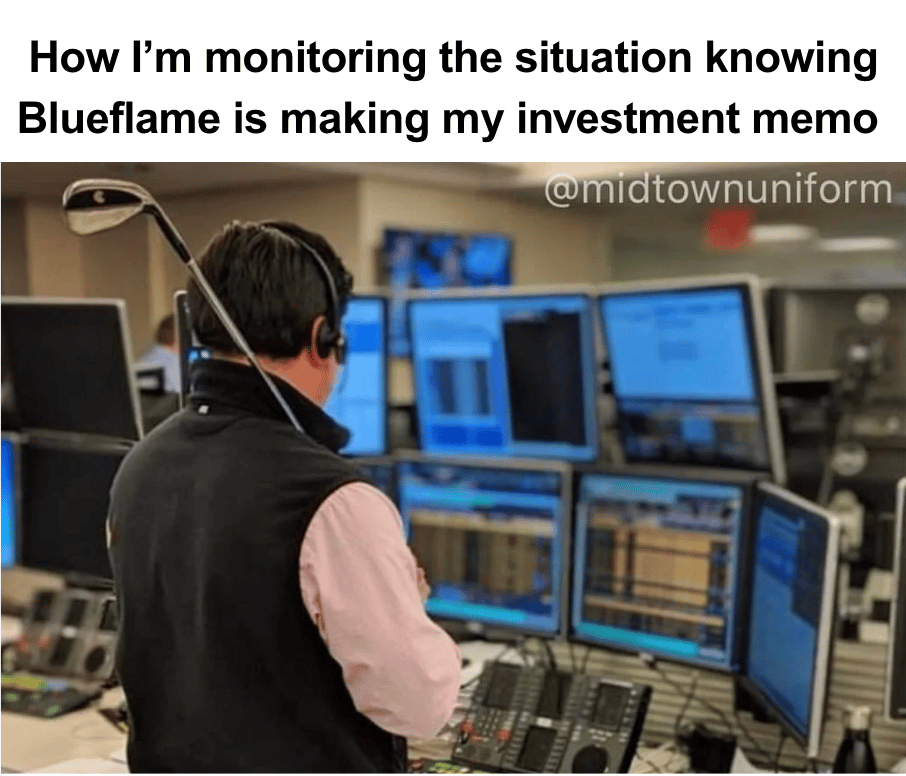
For years, breaking into banking meant earning your stripes in PowerPoint. That trade is dying.
Purpose-built AI is quietly reshaping the deal lifecycle. No, your favorite AI alone won’t cut it. Foundation models are table stakes. The real edge is software that automates the 80% every firm does the same way (memos, decks, CIMs) so teams can spend real time on the 20% that actually wins mandates: judgment, relationships, pattern recognition.
For juniors, this means less formatting and more deal reps. For MDs? A Bloomberg-style view of the pipeline instead of prompt babysitting.
Learn more about how Blueflame AI is doing this for Wall Street’s top firms.
DAILY ACUMEN
Resting Pulse
Your resting heart rate is one of the most underrated predictors of how long you will live and how well you will perform under pressure. A lower number means your cardiovascular system is doing the same work with less strain, which translates directly into better stress response, faster recovery, and more capacity to think clearly when things get hard.
Most people on Wall Street are walking around with resting heart rates ten to twenty beats per minute higher than they should be, and they have no idea because it never gets measured. The body is essentially idling at high RPM all day, burning through resources just to stay still.
Bringing that number down is not glamorous work. It is months of consistent cardio at low intensity. But the dividend it pays, in years of life and quality of every one of them, is enormous.
ENLIGHTENMENT
Short Squeez Picks
Why leadership traits don’t determine a successful leader
The neuroscience behind letting it go
The Strip comes to the Village
Why it’s harder to use miles to book your flights
Why the rich and powerful want to live forever
MEME-A-PALOOZA
Memes of the Day


📣 Partner With Us: Get in front of an audience of over 1 million finance professionals, business leaders, and policy influencers. Submit a partnership inquiry.
📊 Wall Street Comp & Culture Data: Get the most detailed comp, carry, and culture insights across 800+ Wall Street firms. Explore the data.
📈 Grow With Us: Work directly with the Overheard on Wall Street team to scale your finance brand. Schedule your free consult.
🧢 Wall Street Shop: Explore our collection of finance-themed apparel and merchandise. Visit the shop.
📬 Deals Newsletter – Buysiders: A curated roundup of major M&A, private equity, and VC activity. Plus access to private deal flow. Subscribe here.
What'd you think of today's edition? |
*This is a paid advertisement by Greenland Energy Company.
Reply